

You wrap up a great engagement with a marquee customer. Their CMO is enthusiastic. The numbers are real. Sales is asking when the case study lands.
Eight weeks later, the case study still isn’t written.
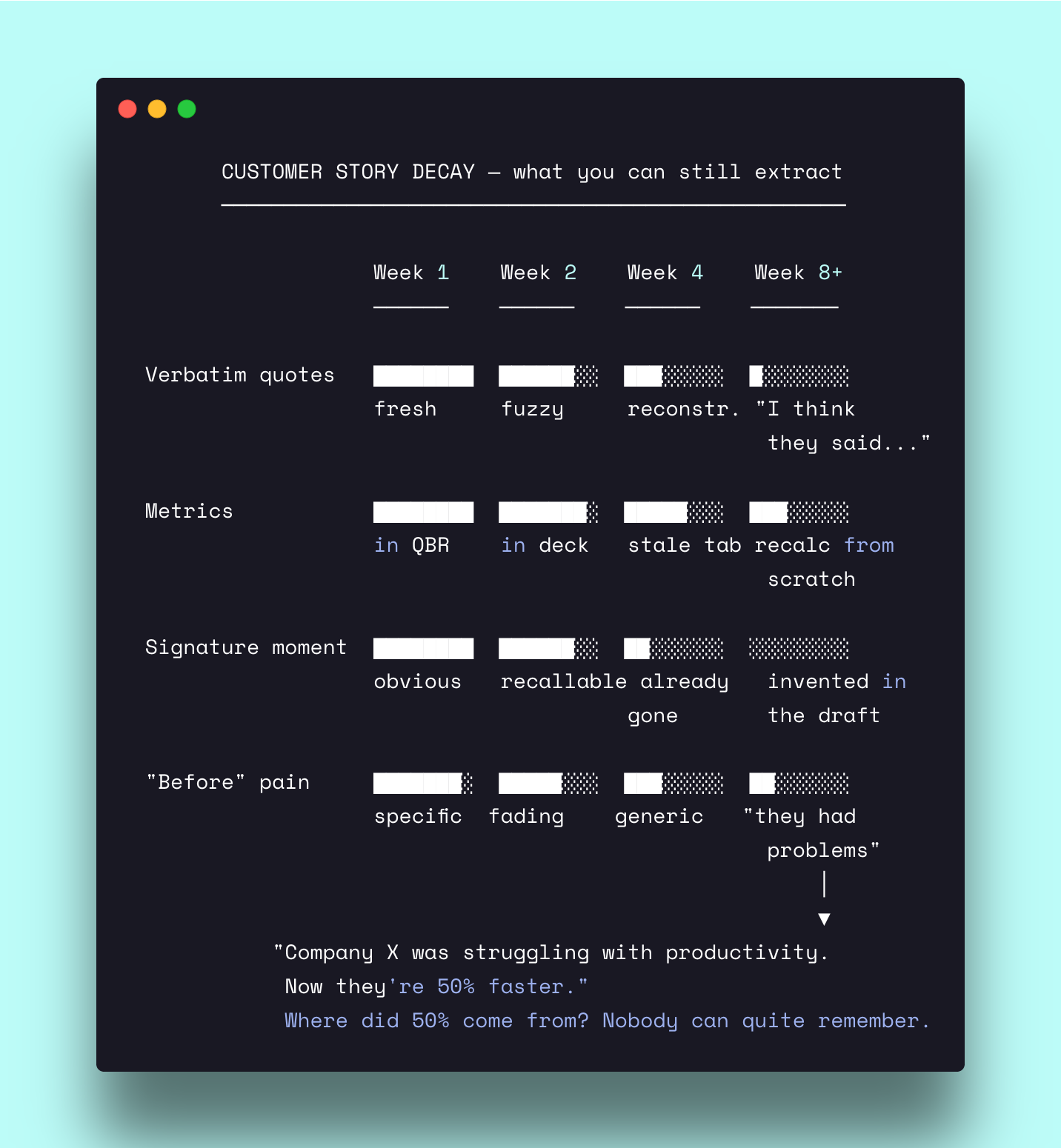
By the time someone sits down to draft it, the verbatim quotes have evaporated. The metrics have to be recalculated from a Google Sheet that’s already three versions stale. The “what made this work” insight that was obvious in May is hard to reconstruct in August. So the writer falls back on the safe template: “Company X was struggling with productivity. Then they used [tool]. Now they’re 50% faster.” Where did 50% come from? Nobody can quite remember. The story ships, gets a couple of LinkedIn impressions, and joins the case study graveyard on the website.
The problem isn’t that your team doesn’t have wins worth writing about. It’s that customer stories degrade fast — and most teams treat case study production as a creative writing exercise instead of a structured extraction process.
When case study production is systematic, every customer win becomes durable proof. The verbatim quotes get captured at the right moment. The metrics trace back to a sourced data point. The “signature moment” — the specific detail that proves the transformation actually happened — comes from the customer’s own words, not the writer’s imagination. And every case study reads like the customer’s voice instead of the marketing team’s voice.
This is the skill I run when a client closes a meaningful win and we have a customer interview transcript or call recording sitting in Granola. It produces a structured 7-section case study with a 25-word hero statement, a 3-metric proof bar, three or more attributed quotes, and explicit [METRIC NEEDED] markers w
herever the data isn’t in the source material yet.
How it works — step by step
The skill runs in three phases. Phase 1 extracts the transformation arc, quote library, and metrics from raw source material (transcripts, customer notes, usage data). Phase 2 builds the structured 7-section narrative. Phase 3 generates derivatives — web format, PDF version, slide-deck snippet — from the same source.
Phase 1: Story extraction
Before writing anything, the skill processes the source material end-to-end:
Transformation arc. Identifies the “before” state (specific pain, with metrics where possible), the inflection point (when the customer adopted the product or shifted approach), and the “after” state (with quantified outcomes). The arc is what makes the story feel like a story instead of a feature pitch.
Quote library. Pulls 3-5 verbatim customer quotes — exact words, with name, title, and company attribution. Never paraphrases into “better” quotes. If the source material is silent on something, the skill marks it
[PLACEHOLDER: need customer quote — pull from G2 or call recording].Metrics table. Extracts every quantified outcome the customer mentioned, with the source for each. Anything unsourced gets
[METRIC NEEDED]. The skill enforces that no metric appears in the final output without a traceable source — no “3x improvement” or “50% faster” pulled from the air.Signature moment. This is the differentiating piece. Most case studies are interchangeable because they live entirely in the abstract: challenge, solution, results. The signature moment is the one specific detail from the customer’s own description that makes the story feel like this customer, not a generic one. The Archive case study has it: “When we got Archive, I didn’t have to do those screenshots anymore.” That’s a specific moment a real human said. It can’t come from the writer — it has to come from the customer data.
Phase 2: Structure development
The skill builds the case study against a fixed 7-section template:
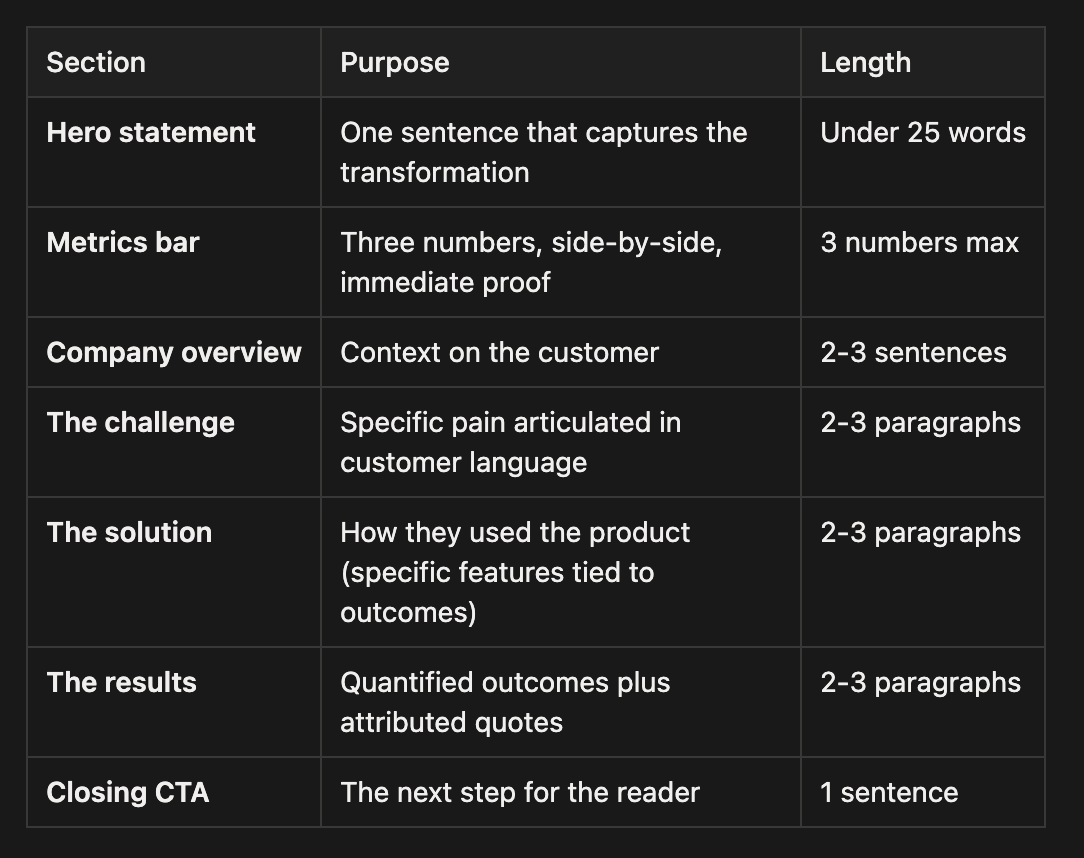
The 25-word hero constraint is what kills generic openers. “Company X was struggling with productivity” doesn’t fit. “POPFLEX was trapped in IG notifications and manual spreadsheets. When they got Archive, they made it into a Taylor Swift song (just saying)” does fit — and it works because the constraint forces specificity.
The metrics bar enforces three numbers. Not five, not zero. Three is the cognitive sweet spot for proof — enough to feel substantive, few enough to remember. If the source material has only one or two real metrics, the skill flags it and asks for more before producing the bar.
The challenge section is where most case studies fail. Generic openers (”struggling with manual processes”) tell the reader nothing. The skill enforces that the challenge be articulated in the customer’s own words — verbatim quotes about the pain, with specific tools, specific failures, specific frustrations. If the source material doesn’t have specifics, the skill flags [CONFIRM: pull specific pain points from interview] and refuses to invent generic pain.
Phase 3: Anti-hallucination guardrails
Sales credibility on a case study dies the first time a customer fact-checks it and finds an inflated metric. The skill enforces five guardrails:
Metrics from source only. Every number traces back to a customer-provided data point or usage report. Anything else is marked
[METRIC NEEDED].Quotes verbatim. Exact customer words. The skill will not paraphrase into “better” or “punchier” quotes.
Mark unconfirmed details.
[CONFIRM: detail]for anything requiring verification (industry context, timeline, attribution).No invented story beats. The signature moment must come from customer data. The skill flags it if the source is silent.
Attribution required. Every quote needs a name, title, and company. No anonymous “a customer said.”
The result is a case study a sales rep can hand to a prospect without flinching, a marketing lead can post on LinkedIn without bracing for a fact-check, and the customer themselves can share with their own internal team because the language is theirs.
See it in action
Setup: You’re at Storyblok, the visual headless CMS. You’ve just wrapped up a global migration project with a major retail customer — let’s call them ChainCo, a multi-country e-commerce business. Their content lead has agreed to a 45-minute interview. The recording lives in Granola. Sales wants the case study live before the next quarterly business review.
Input to the skill: → Granola transcript of the customer interview → Three pre-pulled metrics from the customer’s success-team notes → Storyblok’s product-messaging library (so the “solution” section ties features to outcomes)
What the skill surfaces:
Hero statement (Section 1, under 25 words):
ChainCo ran 12 country sites on a legacy CMS that took six weeks to ship a new template. Now it ships in three days.
Specific pain (six weeks per template). Specific outcome (three days). Specific scale (12 countries). The hero forces the reader past the headline to find out how.
Metrics bar (Section 2):
┌─────────────────┐  ┌─────────────────┐  ┌─────────────────┐
│      3 days     │  │    [METRIC      │  │    12 markets   │
│  Template ship  │  │     NEEDED]     │  │  Live on one    │
│  time (was 6w)  │  │  Conversion     │  │  unified stack  │
└─────────────────┘  └─────────────────┘  └─────────────────┘
The skill marked the middle metric [METRIC NEEDED] because the interview didn’t surface a specific conversion-rate number. Instead of inventing one, the skill flags the gap. The case study won’t ship until that data point is filled in — or until the team confirms that two metrics is enough and removes the third tile.
Challenge section excerpt (Section 4, customer’s verbatim language):
“Every time the merchandising team asked for a new landing-page template, we’d give them a six-week timeline. Then they’d build it themselves in Figma, hand it to a developer, and we’d be back to fighting about why the production version didn’t match the design.”
— Amelia Castillo, Head of Web Engineering, ChainCo
[CONFIRM: title and attribution before publish]
The challenge isn’t “ChainCo struggled with content velocity.” It’s a specific, named pain — the merchandising team going around web engineering because the timeline was unworkable. That’s the pain the reader recognizes from their own organization.
Signature moment (embedded in the Solution section):
“The first time a marketer published a new landing page on a Friday afternoon without filing a ticket, half the engineering team showed up in the channel asking what had broken. Nothing had broken. They’d just shipped a page.”
— Amelia Castillo
That’s the moment the transformation became real. It can’t come from the writer’s imagination. It has to come from the customer telling the story.
Output: A 7-section case study with a 25-word hero, 3-tile metrics bar (one explicitly flagged for follow-up), three attributed verbatim quotes, a named signature moment, and a closing CTA — plus optional derivatives (PDF, slide snippet, LinkedIn post hook). Total time from transcript to draft: ~25 minutes. Total time before the skill: 4-6 hours, plus a quarter of meandering edits.
When to use it
You just closed a recognizable-logo win and the details are still fresh. The customer is enthusiastic, the call recording is in Granola, the success metrics are in last week’s QBR deck. The story will get harder to write every week the team waits — start now.
You have an unprocessed customer interview transcript sitting in Granola. Sales has been asking for new proof points for six weeks. The transcript exists. The skill turns it into a structured case study, a LinkedIn post, and a sales-deck snippet from one source — without making anyone schedule a follow-up call.
Your case study page reads like every competitor’s case study page. Generic challenge, generic solution, generic results. The skill enforces specificity through the 25-word hero, the verbatim-quote requirement, and the signature-moment field — three constraints that make every case study feel different from the last one.
Get the skill
Want to run this yourself? The full skill — 7-section template, signature-moment extraction, anti-hallucination guardrails, derivative generation, and the Granola/Slack pull integration — is open source:
Save the SKILL.md to your .claude/skills/ folder, then run /case-study in Claude Code. The skill handles transcript ingestion, structured extraction, quote attribution, and metric sourcing. Every claim traces back to a source. Anything missing gets a placeholder, never a guess.
This is one of 100+ GTM skills I’ve built in Claude Code to run positioning, content, and launches for Series A-B SaaS companies. If you need the whole system, consider working with me.